The ‘German’ Pretzel and Everything You Need to Know About This Delicious Baked Good!
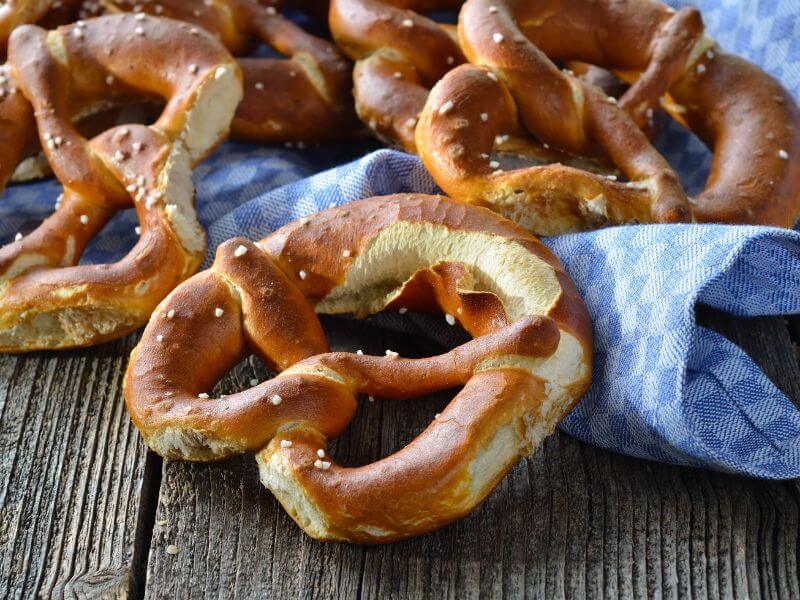
This unique baked good is now widely popular both in Europe and America. This thin and traditionally salty treat is usually made from flour, yeast, water, baking soda, and salt. It has a distinctive knot shape with three openings (holes). The pretzel has a crispy brown crust and a characteristic flavor that results from the Maillard reaction, first observed and analyzed by the French chemist Louis Camille Maillard.
Pretzel dough is dipped in a high-pH solution, which helps the baked product achieve its appealing color and unique flavor. For many years, this solution consisted of water and lye, a substance traditionally used as a detergent by those with limited means, with which women washed clothes. Since lye can be dangerous to use in cooking if not handled properly, the same reaction can now be safely reproduced using the common baking soda familiar to everyone.
There is a wide variety of pretzel types, ranging in texture from soft pretzels, which should be eaten immediately after baking, to hard-baked pretzels that have a long shelf life.
The recipe is said to originate from Europe, with stories dating back to 610 AD. A baker-monk in Southern France would twist leftover dough scraps to resemble two crossed arms, which was the traditional posture for prayer at the time. The monks began giving these small breads to children who learned their prayers well as a reward. They called them by the Latin name “pretiola”, meaning “little rewards.” The pretiola from Southern France eventually spread to Italy, Austria, and Germany, where it is known today as the pretzel.
Pretzels became a symbol in the Catholic Church, as their shape—with three holes—reminded people of the Holy Trinity and symbolized spiritual completeness. In English, the phrase “tie the knot” is also connected to the humble pretzel. In German-speaking countries, it was a tradition for newlyweds to each pull on a pretzel from opposite ends, make a wish, and then eat their piece together, symbolizing their unity. Another pretzel tradition in Germany occurs on New Year’s Day, when children wear a pretzel as a necklace for good luck.
Today, the pretzel is used in Germany as a traditional symbol of the bakers’ guild and appears in many bakery logos.
We are sharing this “traditional” recipe from our master baker, Otmar Fricker. All that’s missing is your own unique touch to elevate it and offer your customers an authentic, delicious pretzel experience!
Ingredients
- 1,400 g Type 70% Strong Flour
- 0,600 g Super American Flour or the full 2,000 g at 55%
- 0,040 g Salt
- 0,040 g Sugar
- 0,020 g Blond Malt
- 0,100 g Butter or Margarine
- 0,100 g Yeast
- 0,050 g Kenfrost Kenfood
- 1,000 g Water
Caution with use! Caustic soda Kenfood. Pretzel liquid solution: 1 kg of water at 30°C, 50 g caustic soda Kenfood (no more, sodium hydroxide). The solution should be prepared one day before or a few hours before use, and always stir very well.
Instructions
- Knead all ingredients together for 3 minutes at speed 1 and 6–8 minutes at speed 2, until the dough is smooth and slightly firm.
- Immediately divide the dough into 120 g pieces.
- Shape each piece into 40 cm long ropes and form the characteristic pretzel shape.
- Let the pretzels rise for 30 minutes at room temperature (outside the proofer). Then, freeze them thoroughly.
- Allow the frozen pretzels to thaw slightly for 2–3 minutes, then dip them thoroughly in the caustic soda solution.
- Sprinkle with coarse salt or sesame seeds, score the surface, and bake immediately at 180–200°C for approximately 12–15 minutes with the lid open, without steam.
Tips:
- For freezer storage, add 2–3% improver suitable for freezing.
- Prepare the caustic soda solution one day in advance.
- Always wear gloves when handling caustic soda and dip the dough carefully.
- The dough should be on the firmer side.
- Instead of salt, you can sprinkle pretzels with sesame seeds, grated cheese, herbs, or spices. For sweet pretzels, sprinkle with cinnamon and sugar—a tasty option for breakfast or snacks for work and school.
- Pretzels are also a great choice for cold sandwiches with various fillings.
At Loulis Mills, for seven generations, we have always supported professionals in the industry, focusing on continuous education, development, and updates. Subscribe to our newsletter here to be the first to receive useful articles, industry news, and information about recipes and products that interest you!