Lagana: Everything You Need to Know…
History
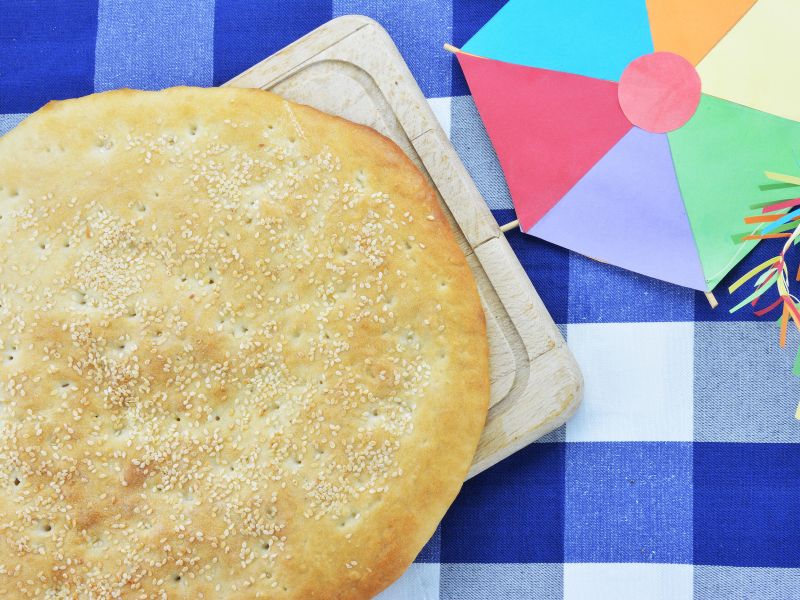
Lagana is an unleavened bread traditionally made in Greece only once a year—on Clean Monday. Unlike most breads we know, it is a flatbread with a thin crumb and a crisp crust. Its distinctive taste characterizes the day and marks the beginning of Lent.
Its name comes from the ancient Greek word “laganon,” a flat dough made from flour and water. Unleavened bread was used by the Israelites on the night of their Exodus from Egypt under Moses’ guidance. Thereafter, Mosaic Law required it during all the days of Passover—until Christ, at His last Passover, blessed leavened bread.
The history of lagana has roots in antiquity and continues to this day. Aristophanes, in Ecclesiazusae, writes “Lagana pettetai,” meaning “Laganes are being made.” The Roman poet Horace also mentioned lagana, calling it “the dessert of the poor.” The tradition of lagana has remained unchanged, and today this special bread is prepared with devotion and care by Greek bakers.
Lagana: The Bread of Clean Monday
The term “Clean” (Clean Monday) comes from an old household custom: on this morning, women would thoroughly scrub all cooking utensils with hot water and ash, then leave them unused until Lent ended. On this day, families would go outdoors, lay out a “proper” tablecloth on the ground, and enjoy Lenten foods such as lagana, pickled vegetables, halva, olives, and taramas.
Kyra Sarakosti
Another tradition linked to Clean Monday—now fading—is the lagana shaped like a woman called Kyra Sarakosti. She has a cross on her head or chest, no mouth (symbolizing fasting), hands folded in prayer, and seven legs, representing the seven weeks of Lent. A common custom was to cut off one leg every Saturday to mark the passing of time. The final leg was cut on Holy Saturday and hidden in a dried fig or walnut—the person who found it was considered the “lucky one” for the coming year.
How is lagana made?
For the traditional recipe you need flour, yeast, water, salt, spices, sometimes sugar and fats, and plenty of sesame seeds on top. Before baking, the surface is brushed with boulamas or flour paste so that the sesame adheres and the bread develops its crisp, sesame-rich flavor.
However, it is also interesting to experiment with more creative variations that are just as delicious and offer a unique taste. Try making lagana with whole-wheat flour, with green or black olives, sun-dried tomatoes, peppers, onions, or other ingredients that can be added to the dough to give it a distinctive flavor. Beyond taste, you can also experiment with different shapes. You can find our own recipes for tasty, crispy laganes here.
Recipe for Boulamas (sesame paste for brushing)
Ingredients:
- 500 g coarse flour
- 1000–1500 g lukewarm water
- 10 g honey
- 20 g tahini
Method:
Mix all ingredients together and brush onto the dough.
What if we have leftover laganes?
Because lagana is sold only on Clean Monday, you might have leftover breads that cannot be sold on other days like other long-shelf-life breads. As an alternative, leftover lagana can be turned into aromatic croutons or rusks. Cut it into cubes or thin slices, depending on your goal. Spread them on a baking tray lined with parchment paper, drizzle with a little olive oil, sprinkle with herbs (coarse salt works wonderfully), and bake. Once cooled, package them in an attractive bag sealed with a sticker or ribbon and place them in your display case for sale.
If you need this in a shorter, article-style format or adapted for marketing use, I can prepare that too!